


Table of Contents
- How Art Supports Mental Health: What the Evidence Shows
- Art Activities for Anxiety: Accessible Options by Need and Ability
- Art for Stress Relief: How Creative Practice Calms the Body and Mind
- Mindfulness Art Activities: Staying Present Through Repetition and Focus
- Art Therapy vs. Self-Guided Art: Understanding the Difference
- Building Emotional Well-Being: Self-Esteem, Resilience, and Social Connection
- Potential Discomfort and Risks: What to Watch For
- Measuring Your Own Outcomes: Tracking What Works for You
Last Updated: October 16, 2026
How Art Supports Mental Health: What the Evidence Shows
Art for mental health works by giving you a structured, low-stakes way to process emotion, settle a racing nervous system, and rebuild a sense of capability.
That distinction matters, and it is where most articles on this topic go soft. At The Painting Hermit, we sell art supplies, so we have an obvious bias toward telling you creativity fixes everything. It does not.
Below, we break down what creative practice actually does, where the evidence is strong versus thin, which activities fit which kind of bad day, and how to tell the difference between a hobby that helps and a problem that needs a professional.
What Research Says About Creative Practice and Well-Being
Creative practice supports mental well-being through a few overlapping mechanisms: emotional expression, distraction from rumination, mild physical relaxation, and the small confidence boost that comes from finishing something.
The American Art Therapy Association's overview of art therapy draws a clear line between art making as a wellness practice and art therapy as a clinical profession. Both can help.
What we can say with confidence is that creative activity tends to reduce stress markers and improve mood in the moment. What is harder to claim is that a coloring book will treat depression. Anyone telling you otherwise is selling something.
The Limits of the Evidence: What Art Can and Cannot Do
Art can lower day-to-day stress, give you a way to name feelings you cannot articulate, and build a habit of finishing things. Art cannot diagnose, treat, or cure a mental health condition on its own.
A lot of the research on creative practice is small-scale and short-term. That does not make it worthless. It means you should treat art as one supportive habit among several, alongside sleep, movement, and connection, rather than as a standalone intervention.
If you are dealing with persistent low mood, panic, or intrusive thoughts, creative practice can sit alongside professional care. It should not sit in place of it.
Art Activities for Anxiety: Accessible Options by Need and Ability
The best art activity for anxiety is the one you will actually do when you are anxious, which usually means something low-effort, repetitive, and forgiving of mistakes. Matching the activity to your energy level matters more than matching it to your skill level.
Here is how we would sort the options by what you have available that day:
Your State |
Best Fit |
Time Needed |
Why It Works |
|---|---|---|---|
Wired, can't sit still |
Freeform doodling |
5-10 min |
No setup, no rules, absorbs restless energy |
Tense, jaw clenched |
Coloring intricate pages |
20-30 min |
Repetition pulls attention off the stressor |
Numb, flat |
Paint-by-number kit |
1-3 sessions |
Clear structure removes the "what do I make" barrier |
Overwhelmed, scattered |
Zentangle-style pattern drawing |
15 min |
Simple strokes, no planning, easy to restart |
Low-Effort Options for High-Stress Days
On a genuinely bad day, the barrier is not skill, it is decision-making. Anything that requires you to choose a subject, mix colors, or plan a composition will lose to the couch.
That is why coloring books and pattern drawing work so well in this window. The Zen Garden Artist's Coloring Book is built for exactly this: 31 intricate designs printed on one side only, so bleed-through is not a problem and you can pull a page out cleanly when you are done. No planning required. Just color.

Doodling counts too. So does tracing. The point is to get your hands moving before your brain talks you out of it.
Structured Activities for Deeper Engagement
When you have more capacity, a structured project gives you something a quick doodle cannot: a sense of progress across sessions. That is where the confidence piece starts to build.
Paint-by-number kits are the most accessible entry point here, because the decisions are made for you and the result is genuinely satisfying. If you want something that trains attention more deliberately, Zentangle Basics, Expanded Workbook Edition walks you through 25 original tangles using only pencil, pen, and paper, with warm-up exercises and a practice section built in. It is 32 pages, costs less than a sandwich, and requires no artistic talent whatsoever.
Art for Stress Relief: How Creative Practice Calms the Body and Mind
Art for stress relief works on two levels at once: it occupies the part of your mind that would otherwise replay the day, and it gives your body something physical to do with the tension.
The physical piece is underrated. Hands moving, shoulders dropping, breath slowing. Many people find that a repetitive task like coloring or pattern drawing produces the same settling effect as other quiet, focused activities.

The mental piece is where the real payoff sits. When your attention is fully occupied by a specific, bounded task, there is less room for the looping thoughts that keep stress alive. That is not a trick.
Mindfulness Art Activities: Staying Present Through Repetition and Focus
Mindfulness art activities are creative tasks that anchor your attention to a single repeated action, so your mind has something concrete to return to when it wanders. Repetition is the mechanism. Focus is the result.
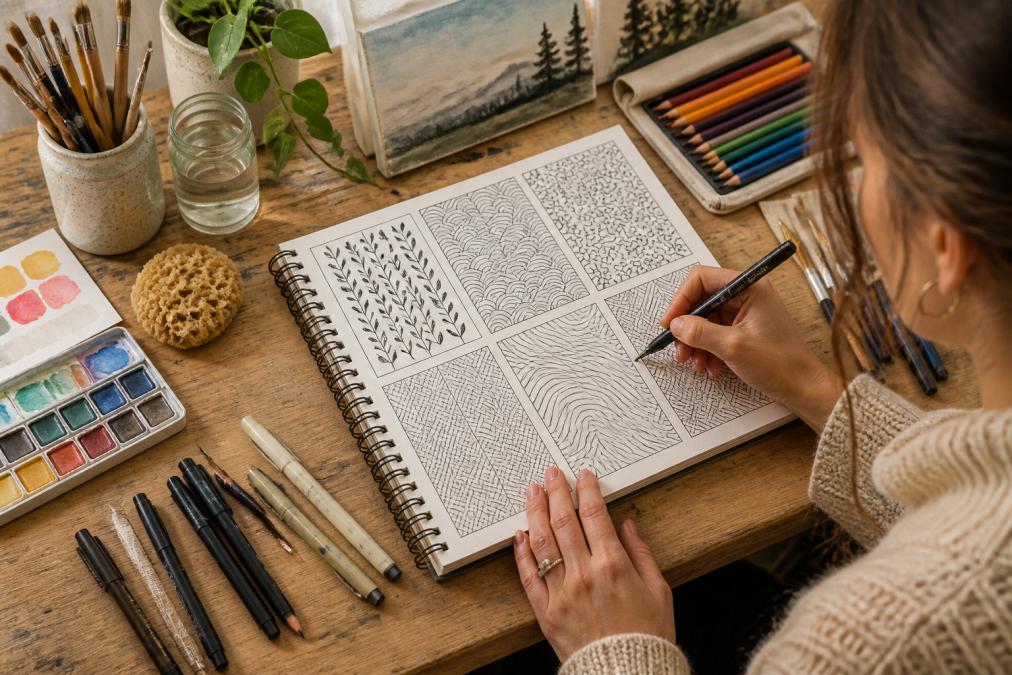
Pattern drawing is the clearest example. You draw one stroke, then another, then another. When your attention drifts, the next stroke brings it back. Over 15 minutes, that is a lot of small returns to the present moment.
Coloring works the same way if you slow down and pay attention to the pressure of the pencil and the edges of the shapes. The difference between coloring as a distraction and coloring as a mindfulness practice is entirely in how you approach it.
Art Therapy vs. Self-Guided Art: Understanding the Difference
Art therapy is a clinical service delivered by a trained, credentialed professional who uses creative process within a therapeutic relationship. Self-guided art is exactly what it sounds like: you, your materials, and whatever you choose to make.

Both have value. The difference is the presence of a trained clinician, a treatment plan, and a professional relationship. If you are working through trauma, grief, or a diagnosed condition, the clinical version is the one designed for that work.
If you are managing ordinary stress and want a sustainable outlet, self-guided creative practice is a strong, affordable, and flexible option. You do not need a referral to start.
When to Seek Professional Support
Seek professional support when creative practice is not enough, or when the problem is bigger than a hobby can hold.
Concrete signs it is time to talk to someone:
- Low mood or anxiety that persists for weeks and interferes with work, sleep, or relationships
- Thoughts of harming yourself or others, which warrant immediate help
- Distressing memories or images that surface when you slow down
- Substance use you are using to manage how you feel
Creative practice can continue alongside professional care. It is not either-or.
How to Choose an Art Therapy Provider
Choose a provider with specific, verifiable credentials rather than a general "art therapist" title. In the United States, the recognized credential is the ATR (Registered Art Therapist) or ATR-BC (Board Certified), issued through the Art Therapy Credentials Board. Licensing requirements vary by state.
Ask three questions before you book:
- What credentials and state licensure do you hold?
- What is your approach to the specific issue I am bringing?
- How will we know if this is working?
A good provider will answer all three without hesitation. If they cannot, keep looking.
Building Emotional Well-Being: Self-Esteem, Resilience, and Social Connection
Creative practice builds emotional well-being through accumulation rather than breakthrough. You finish small things, you tolerate imperfect results, and over time you trust yourself more.
Self-esteem comes from evidence, not encouragement. Every finished page is evidence that you can start something and see it through, even when it is not perfect.
Resilience builds the same way. You make something ugly, you keep going, you make the next thing. Creative practice is one of the few low-stakes environments where failure costs you nothing and still teaches you something.
Social connection is the piece people miss. Sharing what you made, even with one person, turns a solitary habit into a relationship.
Potential Discomfort and Risks: What to Watch For
Creative practice is low-risk, but it is not risk-free. Knowing the failure modes in advance is how you avoid quitting in week two.
The main ones:
- Frustration and self-criticism. If you are a perfectionist, a blank page can become a referendum on your worth. Use structured formats like coloring or paint-by-number until that settles.
- Emotional surfacing. Slowing down can let difficult feelings come up. If that happens repeatedly and intensely, that is a signal to work with a professional, not to push through alone.
- Physical strain. Long sessions at a desk cause neck, wrist, and eye strain. Take breaks every 30 minutes.
- Supply disappointment. Cheap materials that bleed, tear, or arrive damaged kill momentum fast. Buy from a seller with a clear return policy.
Measuring Your Own Outcomes: Tracking What Works for You
Track your practice the same way you would track any habit: one or two simple measures, recorded consistently, reviewed monthly. Vague impressions are unreliable; a short log is not.
Keep it to three fields:
- Mood before and after on a 1-5 scale
- Minutes spent, so you can see whether duration correlates with effect
- One word for how the session felt
After four weeks, look for patterns. Maybe coloring works on weeknights and painting works on weekends. Maybe 20 minutes is your threshold and 45 is too long. Maybe nothing is moving, which is useful information too.
If your log shows no change after a month of consistent practice, that is not a personal failing.
Stress does not wait for a convenient moment, and the habit that helps you most is the one you can start in the next ten minutes with what is already on your shelf.

