


Table of Contents
- How to Improve Art Skills Quickly: Start With a 30-Day Plan
- How to Practice Drawing Effectively (Not Just Often)
- Daily Drawing Exercises for Beginners: 15 Minutes That Work
- Build an Art Practice Routine for Beginners You Can Keep
- How to Tell If Your Art Skills Are Actually Improving
- Common Mistakes That Slow Down Fast Art Improvement
- Conclusion: Keep the Streak, Not the Pressure
- Frequently Asked Questions
Last Updated: October 15, 2026
How to Improve Art Skills Quickly: Start With a 30-Day Plan
The fastest way to improve art skills is short, focused practice every day, not marathon weekend sessions. This guide from The Painting Hermit lays out a 30-day plan built on 15-minute daily blocks. You will draw, paint, and track progress in small steps.
Most people quit because they aim too big. A daily sketch beats a monthly masterpiece.
Below, we show you exactly how to build the habit, what to draw, and how to tell it is working. The plan fits around a full-time job.
How to Practice Drawing Effectively (Not Just Often)
Effective drawing practice means working on one skill at a time with clear intent. Random doodling feels good, but it rarely builds accuracy or control.
Here is how to practice drawing effectively:
- Pick one target skill per week, such as circles, proportions, or shading.
- Warm up for two minutes with loose lines and shapes.
- Draw from life, not from memory, for most of the session.
- Review your page and name one thing to fix tomorrow.
The National Gallery of Art's drawing resources offers free reference material on line, form, and light.
Daily Drawing Exercises for Beginners: 15 Minutes That Work
Fifteen focused minutes a day beats two hours once a week. Short sessions keep your hand-eye coordination sharp and your habit alive. The trick is that the 15 minutes should change as you improve, a routine you never adjust stops working after about three weeks.
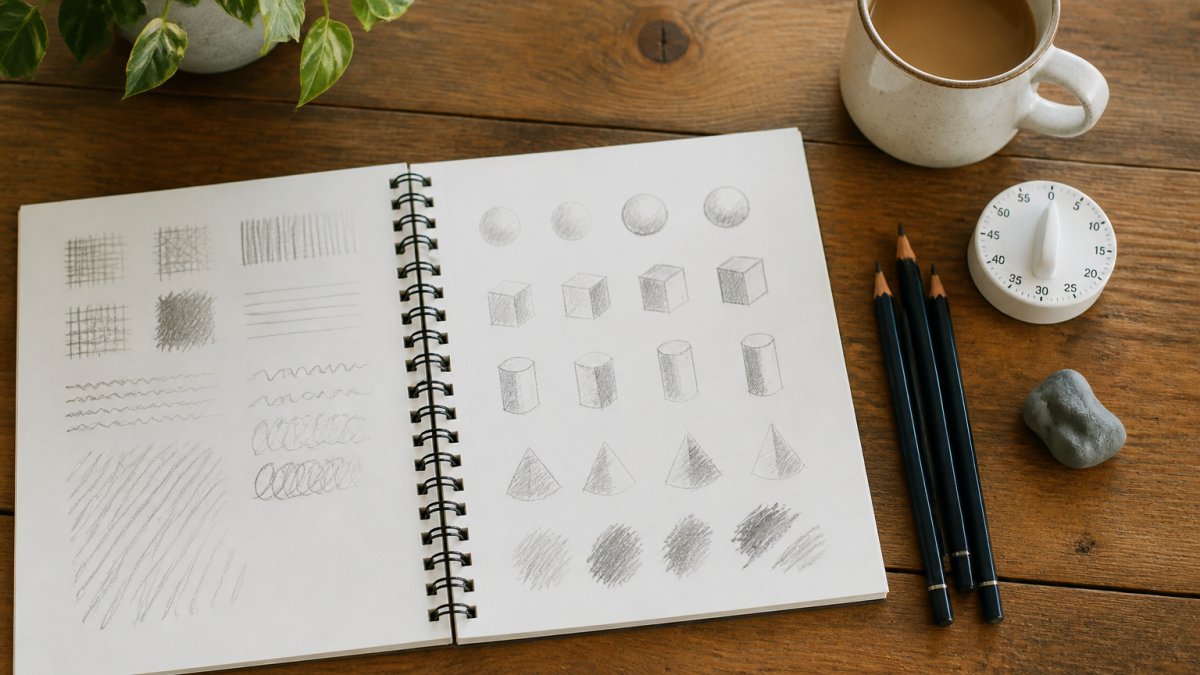
The 15-Minute Block, Broken Down
- Minutes 1-3, Warm-up. Fill one page with circles, straight lines, and ellipses. Do not erase. The goal is a loose wrist, not clean marks.
- Minutes 4-9, One focused study. Draw a single ordinary object from observation: a mug, a shoe, a houseplant, your own non-drawing hand. Set the object down and do not move it.
- Minutes 10-13, Shade it. Pick one light source and commit. Squint at the object to find the darkest dark and the lightest light before you touch the pencil.
- Minutes 14-15, Review. Write one sentence: what improved, and one thing to fix tomorrow. This sentence is what makes tomorrow's session deliberate instead of random.
A Four-Week Progression So the Routine Keeps Working
Most beginners run the same drill for a month and plateau. Rotate the focus weekly instead:
Week |
Focus |
What changes in minutes 4-9 |
|---|---|---|
1 |
Line control |
Draw the object using only straight lines, no curves |
2 |
Proportion |
Draw the object, then measure it with your pencil and correct the drawing |
3 |
Value |
Draw the object in three values only: light, mid, dark |
4 |
Gesture |
Draw the object in 30 seconds, then 2 minutes, then 5 |
When to Scale Up or Down
- If 15 minutes feels easy and you finish early, add a second object rather than extending the time. Two short studies beat one long one for retention.
- If 15 minutes feels impossible, cut to 8 minutes and drop the shading step. A shorter streak you keep beats a longer one you quit.
- If you miss a day, do not double up the next day. Resume at 15 minutes. Stacking sessions to 'catch up' is the most common way beginners burn out in week two.
The One Rule That Matters
Draw from life, not from memory or a screen, for the focused study. Reference photos are fine for the weekly copy exercise, but observation is what trains your eye to see proportion and value errors in real time.
Our 365 Days of Drawing workbook gives you a themed prompt for every day, so you never stare at a blank page.

Build an Art Practice Routine for Beginners You Can Keep
A good art practice routine for beginners is small, timed, and tied to an existing habit. Attach drawing to something you already do daily, like your morning coffee.
Use this weekly structure:
Day |
Focus |
Time |
|---|---|---|
Monday |
Basic shapes and lines |
15 min |
Tuesday |
Drawing from life |
15 min |
Wednesday |
Shading and value |
15 min |
Thursday |
Gesture drawing |
15 min |
Friday |
Copy a reference image |
15 min |
Saturday |
Free choice or doodling |
20 min |
Sunday |
Rest or review your week |
10 min |
Consistency matters more than session length. Missing one day is fine. Missing three starts to break the habit.

How to Tell If Your Art Skills Are Actually Improving
You are improving if your drawings need fewer corrections and your proportions look right faster. Progress in art is quiet, so measure it on purpose. Subjective feelings lie, on a bad day you will swear you have gotten worse. A benchmark drawing does not lie.
Run a Benchmark Drawing Every 30 Days
Pick one subject you can set up identically each time: a specific mug, a chair, your own hand in the same pose. Draw it in 20 minutes, same medium, same paper size, same light. Date it and file it. Do not look at it again until the next benchmark.
After three benchmarks you have a comparison set. Lay them side by side and score each one against the criteria below.
Score Each Benchmark on Five Criteria
Rate each drawing 1 to 5 on these, and write the score on the back of the page:
Criterion |
What a 1 looks like |
What a 5 looks like |
|---|---|---|
Proportion |
Obvious size errors between parts |
Parts relate correctly at a glance |
Perspective |
Flat, no depth cues |
Consistent eye level and vanishing |
Value range |
All mid-tones, no darks |
Clear darkest dark and lightest light |
Line quality |
Scratchy, hesitant, overworked |
Confident, varied, intentional |
Edge control |
Everything equally sharp |
Soft and hard edges used deliberately |
A total of 25 is not the goal. The goal is that your lowest-scoring criterion tells you exactly what to practice next month. If value is your 2 and everything else is a 4, your next 30 days go to value studies, not more line drills.
Three Objective Signals That Do Not Require Judgment
- Time to first correct proportion. Time how long it takes before your drawing 'reads' as the subject. If that number drops from 15 minutes to 8 over two months, you are measurably faster.
- Eraser count. Count eraser marks per drawing and write the number on the page. A downward trend over a month is real progress, even if the drawing still feels rough.
- Warm-up quality. Keep your first three warm-up pages from each week. Line confidence in warm-ups improves before it shows up in finished work, so it is an early indicator.
What Does Not Count as Progress
- Finishing more drawings. Volume without a named focus is repetition, not practice.
- Buying new supplies. A new brush or pencil changes the tool, not the skill.
- Watching more tutorials. Consuming instruction feels productive and builds nothing. Cap tutorial time at one video per week and spend the rest drawing.
Keep the Oldest Sketchbook
Do not throw away month one. Comparing month one to month three shows growth you cannot feel day to day, and it is the single most reliable motivator when a plateau makes you want to quit.
Common Mistakes That Slow Down Fast Art Improvement
The biggest mistake is practicing without a goal. Drawing the same comfortable subject for months builds confidence, not skill.
Other common mistakes:
- Skipping warm-ups and jumping straight into finished work
- Studying finished artwork instead of fundamentals
- Avoiding feedback because it feels harsh
- Practicing only when motivated
The Smithsonian's artist archives show how even masters drilled basic shapes for years.
Conclusion: Keep the Streak, Not the Pressure
Quick improvement comes from showing up daily, not from grinding for hours. Pick one skill, practice for 15 minutes, and track what changes.
At The Painting Hermit, we make that easier with affordable supplies and low-pressure guidance. Our 365 Days of Feel-Good Art workbook turns practice into a calming daily ritual, and our Pencil Magic guide teaches simple techniques like stippling and impressed lines.

Get started with The Painting Hermit and build a drawing habit that actually sticks.
Frequently Asked Questions
How often should I practice art to improve?
Short daily sessions beat occasional marathon ones. Fifteen focused minutes a day gives you roughly seven hours of practice a month, which is enough to see clear changes in line control and proportion. If daily is not realistic, aim for four or five sessions a week and keep them at the same time so the habit sticks. Consistency matters more than session length when you are trying to improve art skills quickly.
What should I practice first to get better at drawing?
Start with the three basics: straight lines, circles, and simple shapes. Draw them freehand across a page as a two-minute warm-up, then apply them to one ordinary object from life, like a mug or a shoe. This builds hand-eye coordination and observation before you attempt anything complex. Add shading to that same object once the outline feels steady.
How can I tell if my art skills are improving?
Keep dated work in one sketchbook and compare pages from week one and week four. Look for specific changes: straighter lines, more accurate proportions, cleaner value shifts, and fewer erased outlines. Another signal is speed. A drawing that took 40 minutes in week one often takes 20 by week four with the same result. Photograph each page so you have an objective record.
Do I need expensive supplies to improve quickly?
No. A basic graphite pencil set, a sketchbook, and an eraser cover most beginner practice. What helps more is having structured prompts so you actually sit down and draw. Workbooks like 365 Days of Drawing ($22.99) or 15-minute Art Drawing ($24.99) give you a daily task, which removes the blank-page hesitation that stalls most beginners. Upgrade tools once your habits are steady, not before.

